
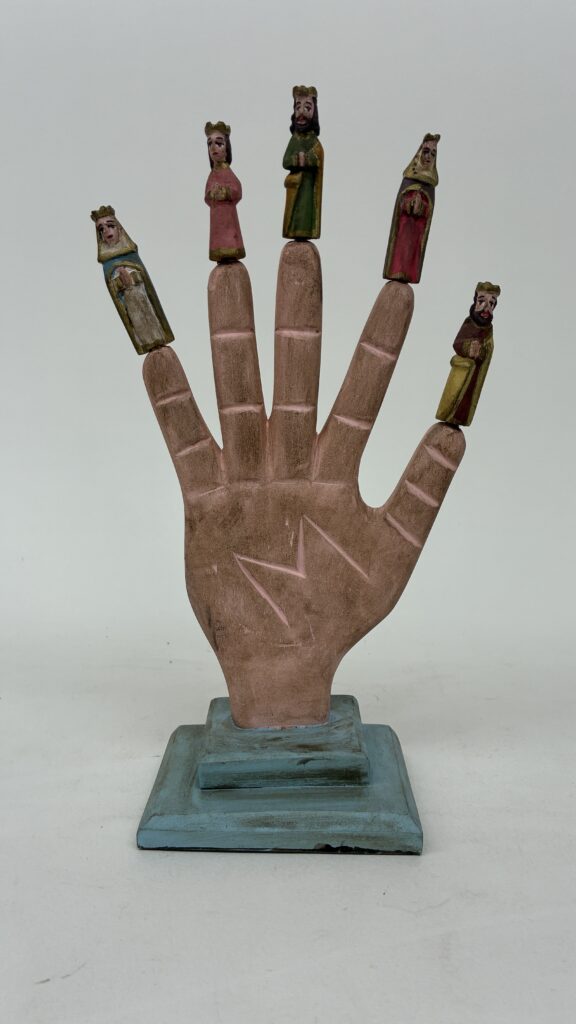
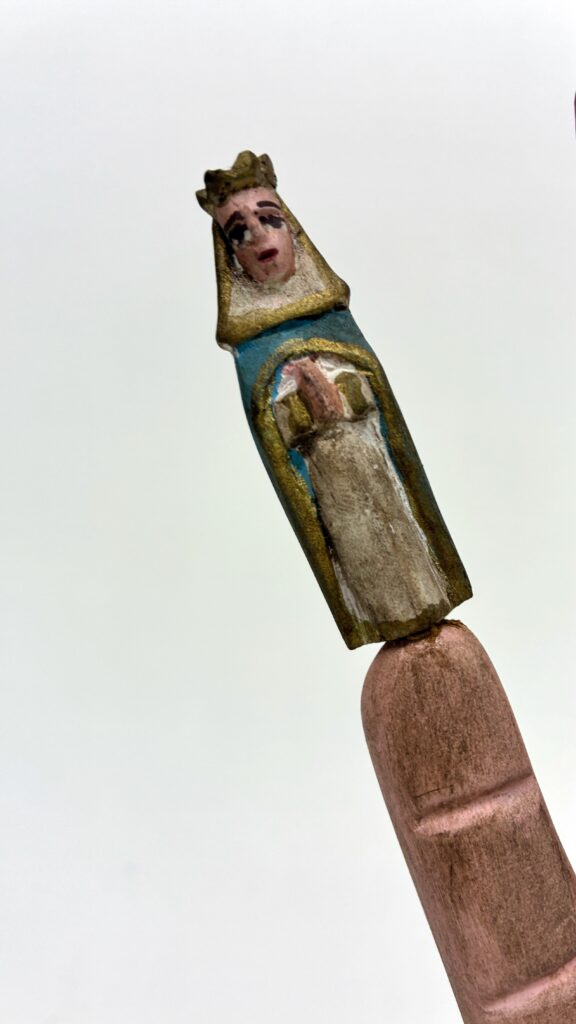
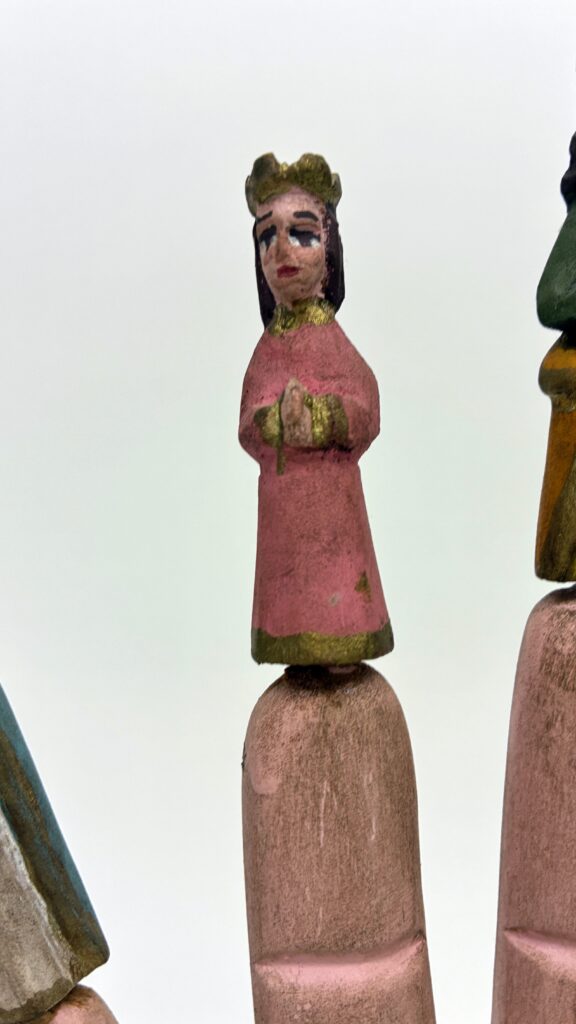
Recently donated to the Godwin-Ternbach Museum by Claudia DeMonte and Ed McGowin, this Mano Poderosa (All Powerful Hand or Hand of God,) stands an impressive 13.5” high (Check out Catalog Record.) Found in their extensive folk collection, this 20th century hand carved wood sculpture may hail from Puerto Rico and is familiar to Caribbean, Central, and South American Catholics. Perched on the tip of each finger are characteristic Las Cinco Personas (The Five Persons or The Five Lords.) Presented are the extended Holy Family on the matrilineal line, with Mary’s mother St. Anne and her son Jesus, displaying three generations in total. Separately sculpted, each figure was later attached to a finger. As a material devotional object of lay tradition, Mano Poderosa might appear on a home altar during the Feast of St. Anne (July 26th) and the Sunday before Nativity of the Virgin Mary (September 8th).
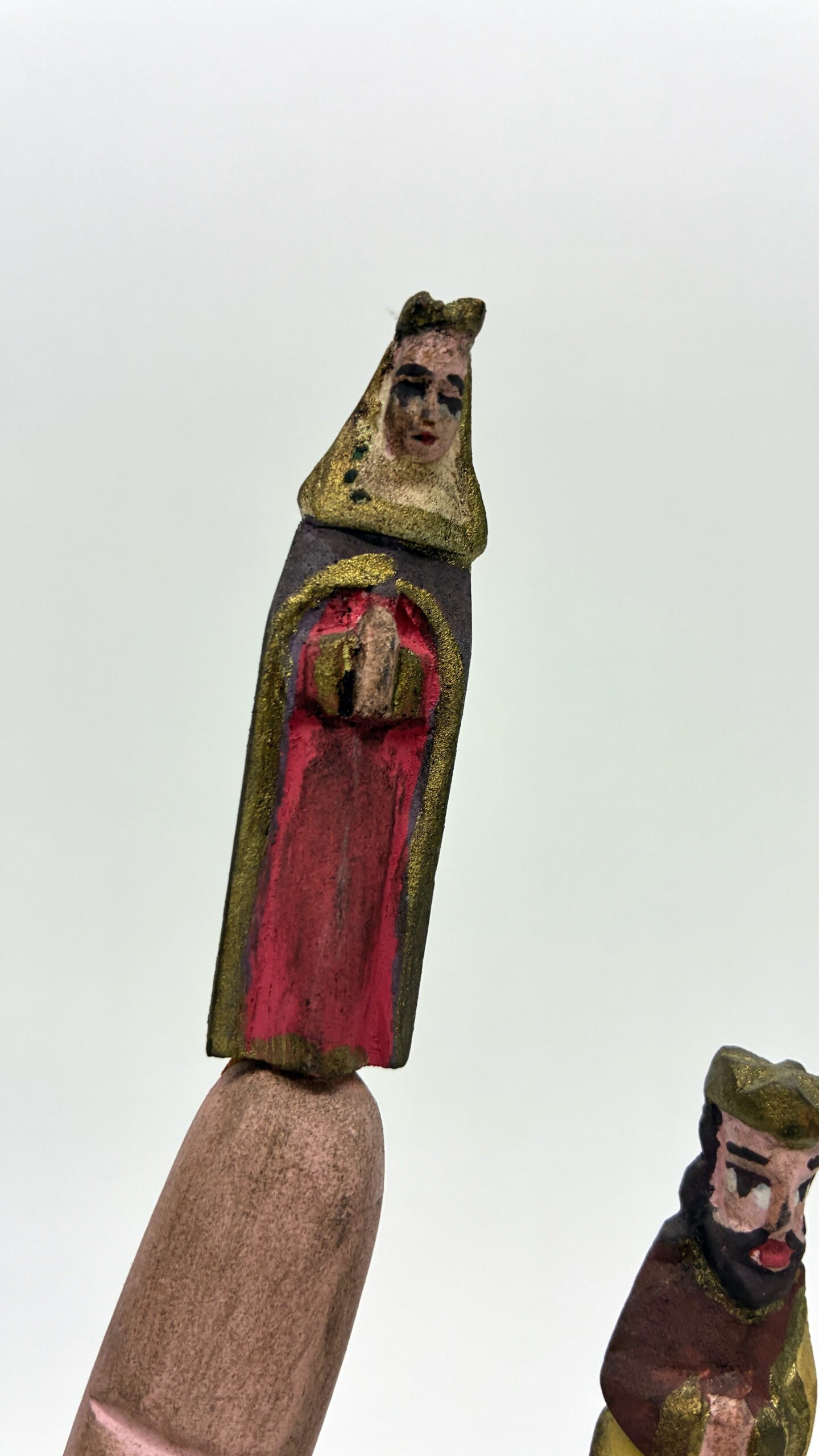

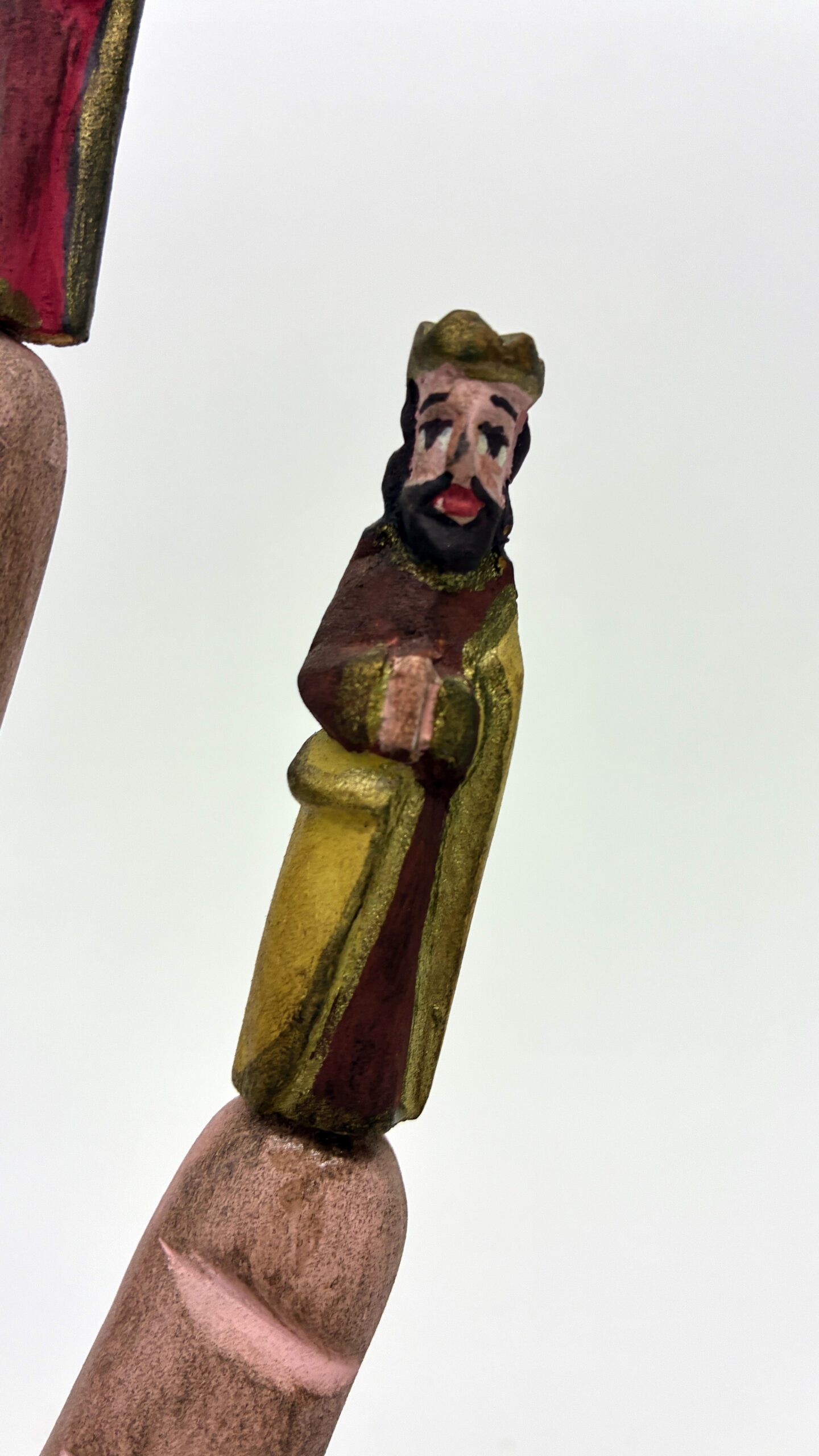
Strikingly, Las Cinco Personas as presented here revise conventional groupings of the Virgin Mary, St. Joseph, Jesus, St. Anne, and St. Joachim. Here appear not three men and two women, but three women and two men. Further research may provide answers to questions such as: which saint replaced the one that was removed? Was this the idea of the artist, or does this different selection of figures reflect local beliefs? Also notable is that this object holds a large letter “M” incised in the palm where stigmata more often resides, suggesting this is the artist’s signature.
Displaying a combination of traditions deriving from the Iberian Peninsula, the Mano Poderosa presents the mobility of religion through folk groups of Latin America, where this arrangement was created. The shape of the hand as a structuring device can be found in such diverse historical examples as the Roman 1st–2nd century Hand of Sabazius, Isaac Holland’s 15th century Die Hand der Philosophen, Henri de Lintaut’s 17th century La Main Alchemique, and in vernacular palmistry diagrams. The contexts from which these diverse objects and images were created range from ancient cults, philosophy, magic, and prophecy.
The iconography of these hands further echo in how the fingers and palms point to individual signs representing parts of entire systems of knowledge. Employed in efforts to translate complex belief and knowledge into plain meaning, the hand and its digits are used to reveal an overall organization in order to avoid misunderstanding. In interpreting how each of the parts refer to the whole, and the whole to the parts, leads to the process of comprehending what could be a map of the entire human body and even the universe.
Associated shapes of disembodied hands present gestures of saints and Buddhist mudras such as this carved stone Vitarka Mudra of the Buddha or Bodhisattva (Check Out Godwin-Ternbach Museum Catalog Record) from 15th–18th century Tibet. Communicating reasoning and teaching, this gesture is identifiable by the curl of the forefinger to the thumb, denoting infinity in the shape of a circle.

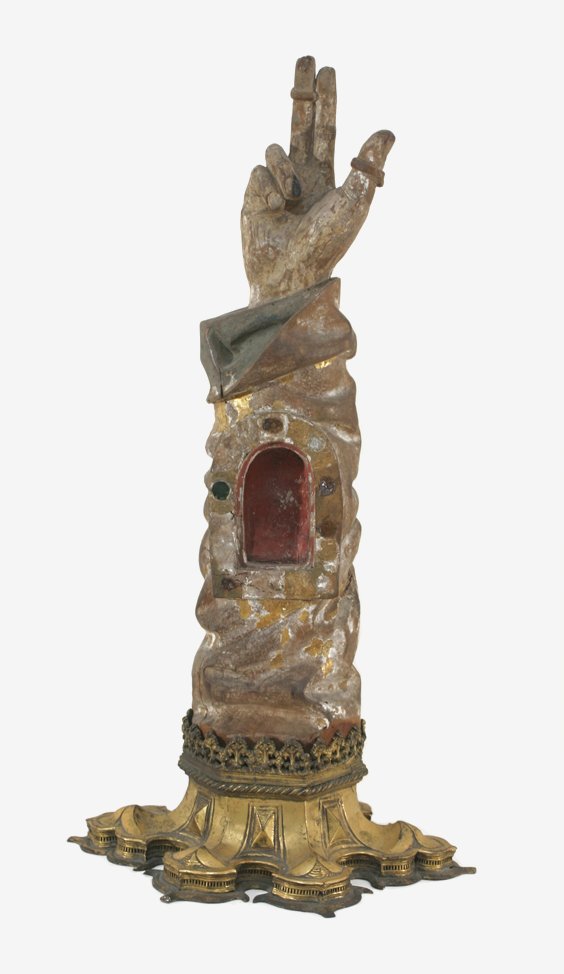
Another example of the importance of the gesturing hand and its connection to a wider body is Reliquary in the Form of an Arm with a Blessing Hand (Check Out Godwin-Ternbach Museum Catalog Record) from 15th century Italy. This reliquary once may have held part of a saint’s forearm bone, as it presents a holding place at this location. This devotional object also reveals how the part comes refers to the whole, as a relic is one piece of an entire body of a saint. This hand, with the pinky and ring finger bent toward the palm, gestures a blessing of reassurance.
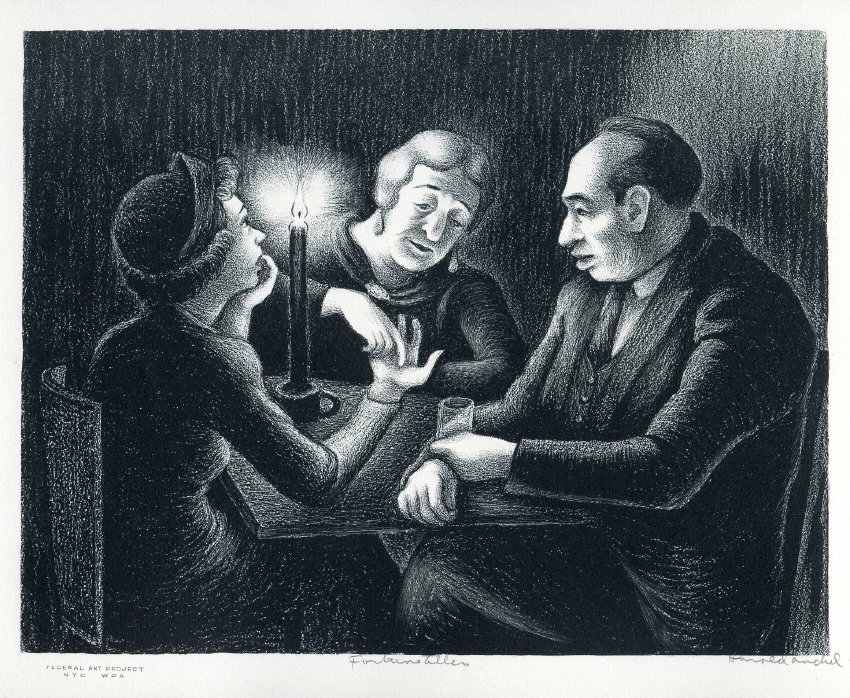
As a symbol, hands are associated with giving, creativity, comfort, strength, and friendship. Through gesture, hands give nuance to stories which voices and text cannot. Each finger can point to elements of a larger complex whole in which we find ourselves. Making meaning through the use of hands and storytelling is also revealed in this WPA lithograph by Harold Anchel entitled Fortune Teller (Check out Godwin-Ternbach Museum Catalog Record), from 1937. By candlelight, a listener and her companion are fascinated by stories told by a woman tracing her lifeline through touch.
Post Written by Mary Billyou
If you are interested in learning more about the Folk Art Collection, please check out the Godwin-Ternbach Museums catalog.
References:
Avilés, Karla Francheska Torres (2011). Made in the Americas? Deciphering the Enigma of the
Mano Poderosa [M.A. dissertation, University of Delaware]. https://udspace.udel.edu/server/api/
core/bitstreams/cb35cbac-8281-4d41-aa89-d314fde689b5/content
Corsini, Theobald, Johann Joseph Hubert, Baron von Conrath (18th century).Sammlung
Alchemistischer Schriften. https://www.digitalcollections.manchester.ac.uk/view/MS-
GERMAN-00003/28.\
Heitsch, Dorothea (2017). Main alchimique et transmutation des signes dans L’Histoire
veritable, ou le Voyage des princes fortunez de Béroalde de Verville, French Forum 42 (2), pp.
175–199.
Hollandus, Johan Isaac (1667). The Hand of the Philosophers: With Its Secret Signs. Restorers
of Alchemical Manuscripts Society (RAMS) https://rexresearch1.com/AlchemyArchives/
HollandusHandPhilos/HollhandusHandPhilos.htm
Varughese, E. Dawson (2023). “Christ the guru’: artistic representation of Jesus Christ in south
India and their mediated notions of guru-ness. In Jacob Copeman, Arkotong Longkumer, &
Koonal Duggal (Eds.), Gurus and Media: Sound, image, machine, text and the digital, UCL
Press.
Young, Lauren (2106). These Eerie Bronze Hands Were Tokens of a Mysterious Ancient Cult:
The Hand of Sabazius is one of the last artifacts of this lost religion, Atlas Obscura.
https://www.atlasobscura.com/articles/these-eerie-bronze-hands-were-tokens-of-a-mysterious-ancient-cu